
Let Them Have Traffic Lights

A recurring theme of the TV show Manhunt is to ask: How much freedom do humans really want?
Note that the question isn’t: “How free are we?” That would be too simple. The series is about an FBI profiler’s quest to track down the “Unabomber”, Ted Kaczynski, a person who fears we have lost something of what it means to be human and are now subservient to machines, rather than the other way around.
At the end of one interview with Kaczynski, the FBI profiler mentions that late one night he found himself sitting at a red light. No one else was on the road, yet the profiler still waited patiently at the intersection for the light to turn green. How free was he in that moment?
Kaczynski said the traffic light is more than a stop sign; it is a symbol of our domestication. The profiler was perfectly free to drive through the red light at any time. But he gives up some of that freedom to live with other people. The sum of this equation is called “society.” Kaczynski desired a return to a mythical period when humans were free of such symbols ruling our lives.
Yet that time never existed. Symbols have always ruled our lives because we want them to. The alternative is that real, flesh and blood humans will rule our lives. And that sounds like oppression – the worst of all possible worlds. We stop at the red light because it is just a red light. If it were a person holding a red light, that would change everything.
But the thing is, the traffic light was created by a real human being called William Potts. The tricolours of the modern came from the railroad system, where red meant “stop,” white meant “go”, and green meant “caution.” Green eventually came to mean “go”, and white was changed to yellow because train conductors were mistakenly seeing the white light for stars at night.
Potts invented the traffic light because by 1920, too many cars were moving on the road, and drivers weren’t listening to the signalling officers. Driving was getting chaotic, not because people weren’t following the rules, but because a person was visibly announcing the rules.
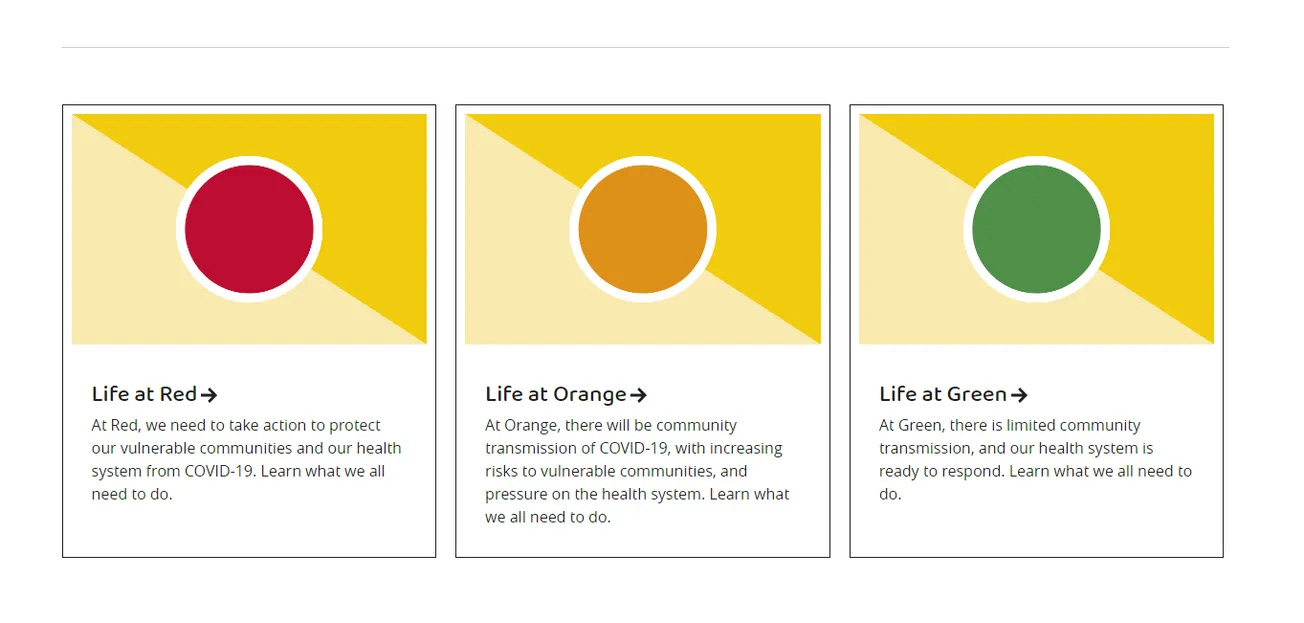
Fast-forward to 2021, when the New Zealand government introduced a “traffic light” system to communicate to Kiwis the present Covid-19 restrictions. Up until then, Prime Minister Jacinda Ardern was the epidemiological equivalent of the traffic officer, telling people what they could or couldn’t do. This is a highly vulnerable situation for any leader.
Every leadership handbook should begin with the maxim: try to get people to be angry at God, not at you. Because no matter how angry they get, God cannot be dragged out of a house and beheaded in the town centre. By using the symbol of a “red light”, people will say, “we’re in red, so I can’t do that”, rather than “Jacinda Ardern says I can’t do that.”
As the Omnipotent Other absorbs all the hate, the restrictions are normalised. Symbols are a neat magic trick to obscure both that a real person is responsible for making the restrictions and to convey the impression of an omnipresent, watchful eye. The return on investment by using symbols for control is ridiculous.
The Omnipotent Other goes by different names depending on the calendar and is the equation of two variables: while humans hate oppression, they are more terrified of freedom. Symbols allow us to say, “We live in a nanny state!” while simultaneously saying, “And thank God!”
Once you know its three characteristics, the signs of this Omnipotent Other are everywhere: it is omnipotent, it opposes the existing disorder, and its sole job is to protect you from yourself. Not from the world: from your bad decisions, from the consequences of your freedom.
For example, while you might call yourself an atheist, if the Chinese restaurant down the road doesn’t have an A4-sized poster above the cash register displaying the Food Safety certificate, you probably won’t buy that bowl of Chop Suey, will you? Of course not, you are a rational person!
Yet that certificate tells you almost nothing about the restaurant’s food hygiene standards. Where is the information about the competency of the inspector who issued the mark? What if the restaurant cleaned up before the inspection, but immediately went back to its dirty habits afterwards? What do the official Food Safety standards actually test? How would you know?
Forget all that, the “A” tells you, in reassuring sans-serif font, that the Omnipotent Other is watching and since the restaurant is open for business, therefore the food must be safe, otherwise the Omnipotent Other would not permit it to exist. All the metaphors of the West imply this Entity, from “free market” to “inalienable rights” to “peace in our time.”
If this is too abstract, here’s another example.
The next time you absentmindedly trip over a crack in the footpath, your instinct will be to blame the crack or at least your own clumsiness. But the crack isn’t the problem. The problem is all the other correctly laid sections of the footpath. Let me break this down because it is important.
You tripped over the crack because the city taught you not to be careful. And you are not being careful because the symbol of a footpath indicates that the Omnipotent Other is in control of this section of Planet Earth called a city.
No one walks absentmindedly in a dense forest. In that location, every step is carefully chosen to avoid tripping over a rock or root. The difference between the city and the forest is the symbol of the footpath. You stop being careful because the symbol implies that you are safe; otherwise, the Omnipotent Other would not permit it to exist. In other words, you tripped on the crack because you believe God will save you from the consequences of your actions.
This is how subtle, everyday symbolic mechanisms work to restrict your freedom. It’s not the police. Forget the surveillance cameras. Ignore the barbed wire. The point of symbolic control is that symbols don’t have a heartbeat, so they can’t be killed, which is the entire reason why people who do have a heartbeat use symbols to reinforce their authority. The traffic light has one simple message: the Other is Omnipotent, Omnipresent and Omniscient – and you are not.
Symbols work not because they oppress us, but because we are terrified of the alternative. Imagine living in a world without the Omnipotent Other. Each step you make on a footpath would need to be carefully placed. You would constantly be asking, Who laid this path? Were they experts? Who certified them? Does that certification signify competency? How do I know?
Imagine trying to buy food in this world. If I don’t know the person cooking my Chop Suey, there is an infinite number of things that could go wrong in the food preparation process. How is the kitchen set up? When was the last time the stove was cleaned? Are the ingredients fresh? Are they washed? What type of water did they use, and is it safe to drink?
This is living in a truly atheistic world. This is freedom. Exhausting does not even come close to describing it. Are you sure you want it? You might hate oppression, but with all the symbols in our world, I know you hate freedom even more. Hence, traffic lights.
Our society values free choice and personal responsibility, and I agree that these are good things. But we are also taught that it is safe to value those things only because we expect a certain amount of absence of choice and freedom from responsibility. Symbols teach us that we would not be allowed to make a truly dangerous choice. Drink Coke, God will save you.
The true danger of the "Nanny State" isn't that it limits your freedoms but that it causes you to want less freedom. Which is great, because that’s what you wanted all along. True freedom of choice would be absolutely, existentially terrifying.
So, here’s a tip for any aspiring libertarian leaders: people will never vote for someone who says it is not the government’s job to protect people from the consequences of their choices. “You son of a bitch, how dare you reveal there is no God. Give me back my traffic lights!”
I’m sure you’ve noticed also that much of the anger towards the Covid-19 restrictions has shifted to a theoretical level: "I don't want the government intruding in my private choices." But the government already does this in a gazillion different, bigger, more important intrusions. The difference is that those intrusions are invisible, wrapped up tightly in symbols. If Jacinda Ardern was still announcing restrictions, the anger would be on a non-theoretical level, if you know what I mean.
The result of the invocation of the Omnipotent Other is that we act like there aren’t people with home addresses and tender, vulnerable throats who are setting the boundaries on our lives. We collectively calculate that the oppression is better than being responsible for our decisions.