
Now What?

I used to say it was way too soon to organise for the system that will replace the progressive liberal regime. Now, I just think it is too soon.
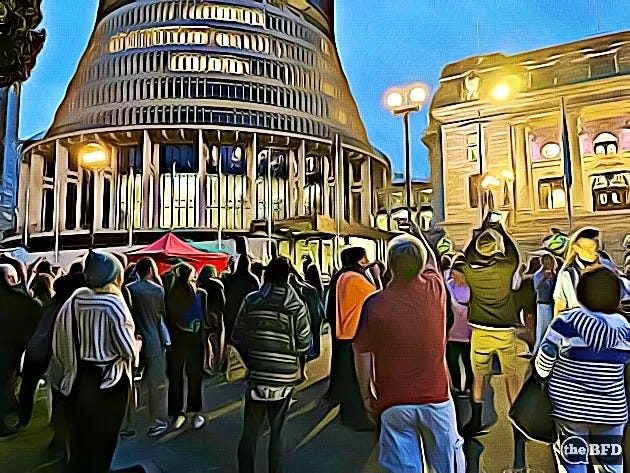
The Wellington anti-mandate protests proved a significant number of Kiwis are not just resistant to progressive propaganda, but willing to actively push back. In the Information Age, this is no small feat. Propaganda has never been more pervasive. If you can see through the lie today, enormous opportunities are possible.
I’m sure a lot of those protestors are now thinking: what can be done with this new civic energy?
This question goes to the core of politics, which is the art of the possible. All regimes exist within constraints. No human is omnipotent, and no system or regime is omnipresent. As in judo, a smart dissident will look for ways to maximise his strengths while constraining his enemy. In other words, he will constantly ask: Does this action help my friends and hurt my enemies? If the answer is no, don’t do it. Politics isn't about fairness or pointing out hypocrisy. Politics is about winning.
If the Wellington protestors want to know what to do next, they must learn that lesson. They must constantly ask themselves: Does this action help my friends and hurt my enemies?
The first thing to know is that each of those protestors is now considered a political enemy by many important people in New Zealand. The protestors may not want to believe this, but it is true. While refusing to see anyone as your enemy is great for a Golden Retriever, it is terminal for a political movement. The first task, therefore, must be to define the word “enemy.”
I understand that the goal of any healthy, strong and courageous leader should be to create a world where all Kiwis are their friends. The correct structure of a good political formula is not to wish one’s political enemies destroyed. Rather, the wish should be to rule your enemies. After all, they are on the wrong path. They need direction. Only you can provide that direction.
This is a good formula because 95% of one’s political enemies are just doing what they are told. While evil certainly exists (anyone who has read about the 20th century will agree with this), almost no one thinks they are doing evil. Everyone thinks they’re doing the right thing. It is important to remember this.
So, how does anyone – even your friends – receive the notion that their actions are good? Through a mix of information and mimicry. Most of us have no idea what to do, so we just copy the cool people. If your political goals are shared by the most fashionable people in society (the nobles), you are, by definition, the regime. Today, the nobles are the political enemies of the types of people who attended those protests. This is true. However, nobles should always be captured, never destroyed.
But we are getting ahead of ourselves.
Right now, the most pressing problem is that New Zealand’s most fashionable and powerful people are aligned against the Wellington protestors. The hard this is they are surrounded by a herd of supporters who simply like to be associated with the cool kids. The question is: how big is this group of people, and how can they be identified?
Is there any data that the Wellington protestors can use to reveal who in New Zealand can be considered their political enemies? Such data wouldn’t have to be exactly accurate. It would just need to be comprehensive (all of New Zealand), current (within the last two years) and relevant.
As it turns out, up until the start of this week, the NZ Herald ran exactly this data set underneath its online masthead: the vaccination rates. These data were a useful proxy for seeing political friends and enemies.
Here’s how to think about these data strategically.
With any significant government action, society splits broadly into four response categories: the “true believers,” the “go-along-to-get-alongers,” the “thresholders”, and the “dissidents.”
The first group of “true believers” represents all the people who know which side of the bread is buttered. For them, obedience has a high ROI. This cohort of people exists permanently above what I call the “threshold of disbelief.” They can watch the movie without nitpicking. For whatever reason – temperament, self-interest, fanaticism, etc – they not only refuse to question the current regime, they see no reason at all to question its rules.
The second group is the “go-along-to-get-alongers.” These people generally follow whatever rules are in vogue and will pivot overnight to hold the diametrically opposite viewpoint without batting an eye. You can call these people “centrists,” but not to their faces. This is like a slur to them. They often have families, a job and always prefer to be left alone, no matter who is in power. The only interaction they have with politics is once every three years at the voting booth.
The third group of “thresholders” doesn’t necessarily like the new rules or the direction of the country, but their personal constraints and responsibilities mean they must follow the rules, but they won’t like doing it. The humiliation is like a stain they can never rub out, and they will forever hate both themselves and the government that forced them into that corner.
The fourth group of “dissidents” have made a principled (or otherwise) stand. Generally, their political antipathy is towards a specific set of rules, because dissidents often have no trouble driving at 50km/h, for example. The Venn diagram of the third and fourth groups often overlap at the margins, oscillating in proportion as government rules evolve over time.
Let’s apply this model to the data collected by the three doses of the Covid-19 vaccine.
At the time of writing, the true believers are most likely found in the cohort that has taken all available vaccines and boosters (53.7%). The go-along-to-get-alongers have taken the first Covid-19 vaccine and one booster but are hesitant to take a third shot (31.9%). The thresholders are stuck on the first vaccine, just to go overseas or back to the office (6.6%), while the dissidents are almost entirely in the final cohort, vaccine-free and loving life (7.8%).
With these numbers in mind, and appreciating some overlap on the edges, a good assumption is that the political enemies of the fourth cohort (vaccine-free) are primarily to be found in the first (true believers) and second (GATGAs) groups. Also, the political friends of the vaccine-free will be found mostly in the third group, with perhaps a few choice picks from the second group.
Remember, none of the people who occupy a different cohort are bad people. Some do want to see those in the fourth cohort dead or expelled from society. But the vast bulk are better defined not as enemies, but as not-yet-friends. As I said above, the ideal goal is to convince all Kiwis that your political movement offers a better vision of the future. A future where the kind of government failures witnessed during the pandemic won't just not happen again, but cannot happen again.
I love the vaccination uptake data. As Napoleon once said, never interrupt your enemy when he is making a mistake.
Why is that data a blessing? Because taking three Covid-19 vaccines is a bit like a permanent social tattoo that says, “I am loyal to the progressive regime.” Two vaccines say, “I am for sale to the strongest bidder.” One vaccine says, “I’m annoyed but can’t act on that annoyance.” And zero vaccines says, “I want to find a way to change all this.”
As I’ve pointed out before, the number of dissident Kiwis is largely irrelevant. What matters is whether this cohort has friends in powerful positions. The most powerful positions of influence in modern society are, in descending order: media, academia and the civil service. If those institutions are dominated by your political enemies, then your movement will fail. Don’t yell at me, this is just how the maths works out.
But now that we know where your friends and enemies are, you can work to place your friends into positions of power, while simultaneously reducing the number of enemies occupying those positions. From now on, you must judge any political action by this metric alone: is this good for my friends and bad for my enemies?
None of this requires any centralised coordination. Each of the Wellington protestors and their supporters can now act during their daily lives in ways that are politically effective. Hire your friends, do business with your friends, play sports with your friends, teach your friends, commune with your friends. Right now, the aim is to win. And you can only do that if your friends are powerful.
The purpose of government is to create the illusion that power does not exist. It does this by maintaining a monopoly of power. In the same way, the greatest trick any regime can play is to convince dissidents that they are alone. Data is the government’s best weapon, but it always comes with a risk of exposing fault lines in a society. And once those fault lines are revealed, the dissident has a path to victory if they know how to exploit it.
Overall, the vaccine uptake proved that Kiwis of all shapes and sizes are mostly willing to do what they are told by a recognised authority. This is a healthy social trait and should not be mocked. A good leader should want their people to be loyal and obedient. However, today they are your enemy’s people. The goal is to make them your people.
It may still be too soon to do anything of substance with the civic energy created by the Wellington protests. But Covid-19 revealed the character of individual Kiwis in an unforgettable way. Now you can see your enemies. Now it's time to connect with your friends. The future of the country depends on it.