
Why Do Catholics Ignore the Internet?

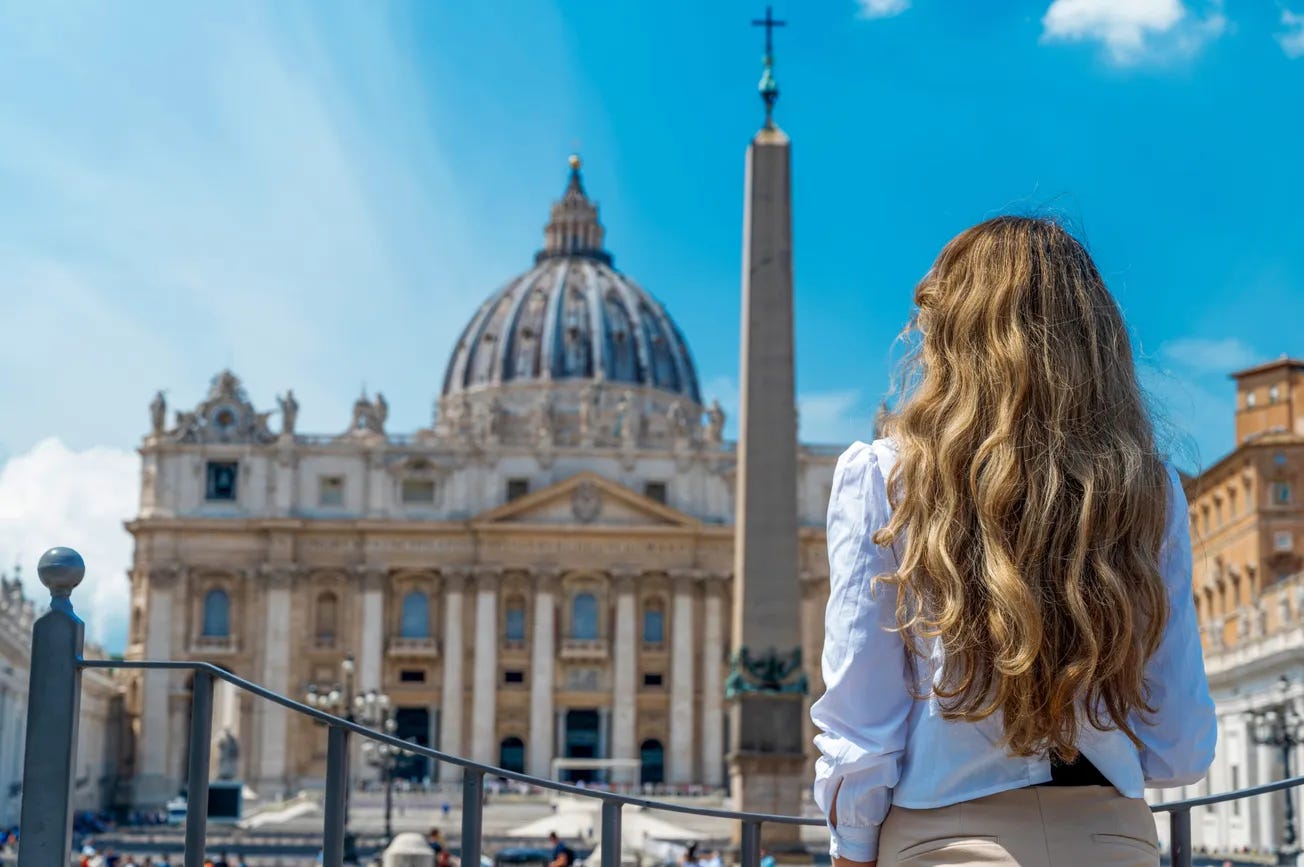
Amazingly, the Vatican posted about the Pope’s death on X even before it updated its own website, and it got me thinking: why hasn’t Christianity taken better advantage of the internet?
I don’t mean why haven’t Christians leveraged the internet; Christians are all over the digital airwaves. I’ve always been curious (and slightly suspicious) about why Christianity never really figured out that the internet was a tool for gaining influence.
Obviously, the answer depends on what you think Christianity really is. As a non-believer, my opinion is probably white noise to believers, but I’ve always thought that Protestantism is just one small step from atheism. Once you start thinking you can interpret the Bible in your own way, you’ve already decided God doesn’t exist. If you really believed in God, you’d be a lot more sceptical about your brain’s capabilities.
I feel a similar way about Orthodoxy, which is blatantly, almost painfully, Oriental. It clearly comes from Russia rather than reflecting a type of Christianity that came to Russia. Ethnic fingerprints on a religion are a key indicator of the very human tendency for people groups to mould God in their own image, not the other way around.
That’s also true of Catholicism. Catholicism is essentially a collection of thoughts on the words of a Jewish person in the first century. Because Romans and Europeans interpreted this, Catholicism became a European religion. That’s why the God of the New Testament appears to have the values of Europeans, while the God of the Old Testament has the values of Jews. Again, ethnic fingerprints are a tell.
Nevertheless, when people hear the word “Christianity”, they think of Catholicism. Even Protestantism is a protest against Catholicism, which means Protestants think Catholicism is the default, too. Likewise, Orthodoxy is a schism from Catholicism, which, again, makes Catholicism the default. I’d also point out that Protestants and Orthodox almost never “convert” to Catholicism if they change their minds. They generally just become atheists. Fundamentally, everyone acts as if Catholicism is the bedrock of Christianity, even if they won’t admit this out loud. I’m happy to admit this.
So, starting with the assumption that Catholicism is Christianity, why hasn’t Christianity leveraged the internet more effectively?
The proximate answer is that the Internet was created by the enemies of Catholicism. If we’re being honest, the US is a Protestant country. Specifically, it is the legacy of English religious shock troops called the Puritans. These people thought they were the “real Jews” of the Bible. They were also indistinguishable in dress from the Spanish Jewish merchants to whom they sold goods, right down to the black skullcap and beard. And, of course, the Puritans practised Old Testament–style politics, if you know what I mean.
After the Puritan dictator Oliver Cromwell died in 1660, a wave of revulsion at the excesses of Puritanism swept through England. The Puritans were then kicked across the Atlantic to Massachusetts, where Puritanism became the spiritual force behind the American Revolution a century later. “Here at last,” the Puritans said when they arrived in the Thirteen Colonies, “we may reign secure.”
And the one thing Puritans hate more than alcohol is Catholicism. That hatred is so integral to the US Constitution that it is written directly into the US Constitution (with a capitalised C). When the Puritans separated religion from the state, the religion they had in mind was Catholicism. It should surprise no one that Protestantism, which defines itself by “personal revelation”, created legal loopholes allowing it to control the US government if it called itself “secular”. Sometimes, if you’re in the right room, you’ll even catch “secular” Americans saying they need to “take back Christianity”. Again, Protestantism is just one step away from atheism.
The internet was invented by these “secular” Protestants and, as such, it reflects the mindset of those who created it. For example, the internet was built to be flat (non-hierarchical), universal, written in English, and free (as in, no charge). Furthermore, the internet prioritises debate, freedom of speech, transparency, prosperity (money-making), and liberalism. Consider also that the internet is a series of disintermediated nodes, with no central control – a quintessentially Protestant worldview.
Catholicism is none of these things. While Catholic literally means “universal”, its version of universality is not like the Protestants’. You can’t have more than one “universal” religion. In the Protestant understanding of “universal”, nobody believes in Catholicism. Hegemony means hegemony. The internet is a Protestant weapon of information warfare created to pursue hegemony over its religious rivals.
The distal answer for why Catholics don’t leverage the internet is entirely their fault.
Catholics don’t really do anything unless they’re instructed, hence the whole hierarchy thing. I’m not sure what a Catholic internet would look like, or even if it is possible for Catholics to invent something like the internet. Unless the Pope says an action is ordained or the Church formalises a doctrine, Catholics aren’t encouraged to think for themselves on big things.
So, if they were to get a green light from Rome, let’s hypothesise a few ways Catholics could leverage the internet.
First off, you need power to do anything. Even if it’s a small piece of power, you can invest that fraction into creating larger amounts of power. Catholics have no power on the internet, so they need some. Some of the key pillars of power are force, money and information. Catholics can’t use force because there’s no app that can slap a person through their iPhone. Money and information are the only routes.
Today, the Vatican does not control the media, but it could create something more powerful than The New York Times. Journalism is not about writing skills; it is about access. Who you talk to and what information you uncover will decide a journalist’s career. While there are ethical restrictions on priests repeating what they hear in the confessional booth, I’m talking about something much simpler.
The Vatican could fund just one parishioner at each of its churches to be the eyes and ears of local (or wider) news. This would be hugely powerful because Catholics are everywhere in society. They are at all levels of the largest companies, and they see a lot of things. But they have no one to talk to about what they see because mainstream media despises Catholics. However, they might talk to a journalist who was also a believing Catholic.
The resulting stories would reflect Catholic priorities and the Church’s worldview. Anyone can write a story about financial crime; the difference is which financial crimes are written about. The same goes for politics or culture. These stories could be loaded onto an app to give relevant news to Catholics that matters to them. Conversation creates fashion; fashion creates prestige; and prestige creates a new elite. The power to inform is the power to govern.
It’s also never been easier for the Vatican to control politics using the internet.
One of the major reasons Catholicism is hated in politics is that you can’t be a Catholic and pretend that a president is your leader. Either the Pope is the emperor of the world and God’s emissary on earth, or he isn’t. A majority Catholic system will always result in the Pope running your country. Everyone in politics knows this, which is why the system tries so hard to propagandise Catholics into “thinking for themselves” like Protestants.
But what if the Vatican created an app that showed the Pope’s position on every policy and election? This could be automated (if the policy is contrary to Catholic doctrine) or tailored. If a Catholic doesn’t know who to vote for in a local or national election, she could check the app to see which candidate (if any) the Church endorsed. Now we’re really talking about power.
Put it this way: at the end of 2023, the global Catholic population was 1.406 billion. In the US, 62 million voting-age adults claim to be Catholic (or 20% of the population). In New Zealand, about 450,000 people are Catholic (6%). If a single app could direct the political actions of 20% of Americans, it wouldn’t take long for the “secular” Protestant system to drop its mask and get rid of democracy altogether to prevent the US from being captured by Catholicism. Trust me on this: the Protestants would torch the world before letting it be controlled by Rome again.
All this information and influence would require funding. A lot of funding.
So, it’s a good thing that Catholics tithe, and the Church holds quite a bit of valuable property. Yet the Church’s tithing system hasn’t leveraged the internet very well. Rather than isolating tithes to support local church activities, why not create a method to funnel global tithes to strategic Catholic campaigns or operations that can best advance the Church’s missionary message or enhance its influence further?
Perhaps a parishioner journalist has uncovered a huge scandal and needs money to do the research or to publish the story. His local church might be too small to support the efforts, but millions of dollars could be made instantly available through zero-interest grants using an app. Or maybe a Catholic political candidate is standing in an election. They would need strategic funding, too. The ability to move money at lightning speed and pinpoint accuracy can be hugely powerful.
There are many other low-hanging things Catholics could be doing to better leverage the internet, such as a boycott app, AI-generated movies, non-usurious loan apps, school education platforms, employment apps, real estate blockchains, and dozens of other easy-to-build things. The smartphone could become the Vatican’s most effective tool.
Unfortunately (or perhaps fortunately), Catholics are unlikely to act on any of this until and unless they get the nod from Rome. Maybe it’s a generational thing. All the cardinals in line to be Pope are too old to understand the internet, but the next generation might notice the incredible opportunity. I still think the religion that dominates the digital world will rule the physical world.
All I’m doing is pointing out the gaps of power and how they might be filled. As Ralph Waldo Emerson said, “Do the thing and you will have the power.”