

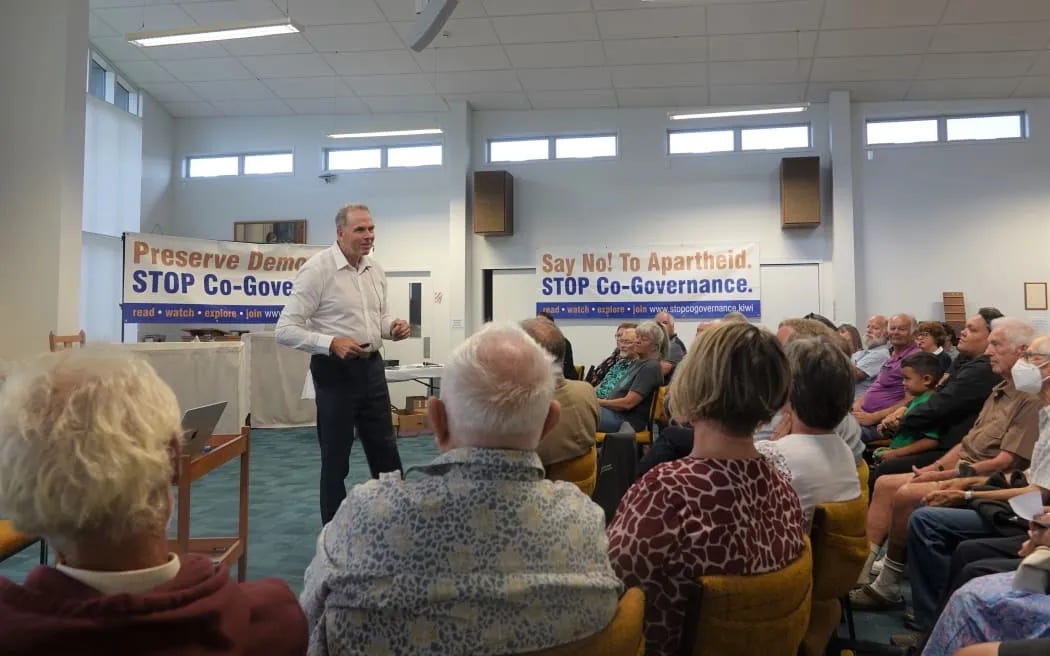
Julian Batchelor fits the exact archetypical profile of the guy who is right for all the wrong reasons.
The founder and chief whip of the Stop Co-Governance movement is also a member of the demographic I like to refer to as “people who have no idea how bad the 21st century will be.” It’s an age thing, which is manifestly obvious by this absolute catastrophe of a website.
Despite having the aesthetics of a Tasmanian devil, Stop Co-Governance does have some interesting insight into the kinds of people Batchelor is up against. It makes a disarmingly clear statement: New Zealand society is under a not-so-subtle attack from racist Maori activists.
Now, that’s not really an abyss most Kiwis want to peer into. But this claim is accurate. Some Māori groups are horribly racist against any ethnicity that isn’t their own, and they are working diligently to Trojan Horse their way into power through the “co-governance” model with the aim of either ridding New Zealand of other groups or dominating them, whichever is easier to achieve.
What interests me about Batchelor’s aversion to such an outcome is that it holds a good lesson about how power works. More specifically, he is a lesson about what not to do if you want power.
Simply put, the problem with the Maori activists is not that they are too racist. The problem is that Batchelor himself is not acting racial enough.
I can feel you shift uncomfortably in your chair, so my logic here deserves an explanation.
Batchelor is of the generation that was heavily propagandised into believing that individualism is the superior value and that any kind of racial cohesion (or any group interest for that matter) is to be detested as a non-negotiable evil.
I don’t want to put words in his mouth, but I suspect Batchelor believes, just like most people, that only the bad guys join forces over skin colour or something equally stupid, like a flag or religion. In fact, I’d wager a decent pile of money that you could call Batchelor a whole dictionary of nasty curse words, but the one that would irk him the most would be “racist.”
Yes, this does make Batchelor a better person than those Maori activists. But I am warning you that this kind of “moral” belief is a losing strategy that will get everyone who thinks like him ruined or killed in the coming century.
People need to get it through their heads that the rest of the 21st century will be far more like the 20th century than we expect. I am not referring to rising wealth and civil rights. You need to change your angle. New Zealand in the 21st century will be like the 20th century in the third world.
The reason for the inevitable, inexorable, unstoppable dissolution of the West into the chaotic, corrupt third world is that democracy is a permanent low-level civil war. Except, rather than fighting each other on the streets, we gather every three years and count heads, as we will once again do on 14 October.
In a democratic system, the only thing that matters is that the loyalty of your group must outweigh the loyalty of other groups. If you can’t command loyalty, you don’t have a group. It’s very simple.
Now, New Zealand was mostly homogenously Anglo-European for most of Batchelor’s life. He is used to discussing luxury things like ideology and politics because everyone around him looked and acted the same (I know I’m being cartoonish, but give me some rope here).
However, in a multicultural society of 20XX, there are too many unknowns between different groups of “Kiwis”, which creates anxiety. Anxiety is the only emotion that never lies, so when people feel anxious, they tend to revert to more straightforward mathematics about life. One of those calculations is to realise a deep truth about humans: that skin colour is our most basic uniform.
With so many unbridgeable unknowns between groups, individuals tend to use shortcuts to find balance in their lives, and this creates what the Indians call “vote banks.” Politicians are successful if they can corral different votebanks into a single voting bloc just in time for the election. But these voting blocs always exist in a fragile quantum state: as soon as you look at them, they disappear.
The game of democratic politics in a multicultural society is to avoid, for as long as possible, any direct description of your voting bloc. The moment your votebank starts asking, “hey, what does a disabled Pakistani immigrant have in common with a Maori activist from Parnell other than being told to hate Julian Batchelor?”, the quantum field collapses and both groups separate again.
The thing about anxiety is it can be dangerous in a low-level civil war. At some point in every multicultural society, no single group will be large enough to claim hegemony over the culture. And since nature abhors a vacuum, other groups will begin to vie for control, knowing that success will afford them more resources (all wars are about scarce resources).
Would you like to know how to win a civil war? Let me give you a hint: it’s not individualism.
Most moderns, deep down, already understand the correct mathematics for surviving a cultural vacuum like the one that is appearing in New Zealand. They’ll kick and scream to avoid saying what is true, but everyone knows that racial solidarity is the only winning hand.
I should clarify here that “racism” is different to “racial” solidarity. To unpack this, let’s go back to Julian Batchelor and his Maori adversaries.
Why does no one seem to care about Maori racism? Conversely, why do people feel justified in saying that Batchelor is a “racist”?
The answer is that the Maori activists are displaying a form of positive racism while Batchelor is displaying a classic case of negative racism.
No one cares about racist Maori activists because, from their perspective, this racism is overtly about the betterment of other Maori, even if most Maori don’t agree with the activists. The activists think they are acting on behalf of all Maori. They genuinely believe they have the moral high ground. And if we’re being honest, this garners respect from the rest of us.
On the other hand, what does Batchelor propose to achieve for people in his ethnic group? What does all his energy against the Maori racists actually do? Don’t say, “it helps New Zealand!” Your nation is what counts, and the core of your nation is your ethnicity. There is no getting around this.
This is the strange paradox of racial solidarity. No one cares about your racism if racism leads to authentic love for the people who look like you. If your racism spends zero energy on hating another group, but all your energy on loving your own group, people will applaud your racism rather than tear it down. They won’t even call it racism. That’s how the world has always worked.
How do I know this is true? I’ve already explained how the Maori successfully deploy racial solidarity as a tool and a weapon. But I will also point out that the two most racially aware countries I’ve ever been to are Israel and China.
Jews and Chinese are often called racist, and I’m sure some of them can be vicious to other groups. But I’m sure you’ve noticed that Israel is thriving, as is China. They support, nurture, hire, assist and commune with each other as a priority. This has been a key factor in the success of these two ethnicities for millennia. Indeed, Jewish support for each other aroused such animosity amongst other groups that it became a folk myth that sadly turned into deep hatred for Jewish people.
Batchelor’s major problem is that he doesn’t understand the difference between being racist and having racial solidarity. His aversion to the former makes him blind to the critical importance of the latter for surviving in the coming multicultural 21st century.
I certainly empathise with Batchelor’s tough position. Europeans like us are the only people in the world who have been systematically propagandised into believing that racial solidarity is evil. You may not believe in racial solidarity, but 100% of the people you are inviting into your country are proud of their racism. I am not asking you to copy their strategy. I am only warning that it’s a terrible idea to expect them to copy your strategy of individualism.
So, I’ll leave you with this. Try to understand that diversity is a weapon to use against your enemies. Solidarity is how you build friends. If you are being told that diversity is a good way to survive the 21st century, I suggest you look again at who is telling you that and start asking why.
The future belongs to those who stick together. I wish this wasn’t so, but it is. It always is.